Black horse
True black is one of the rarest coat colours in the horse, and one of the most striking things you can put on a wall.
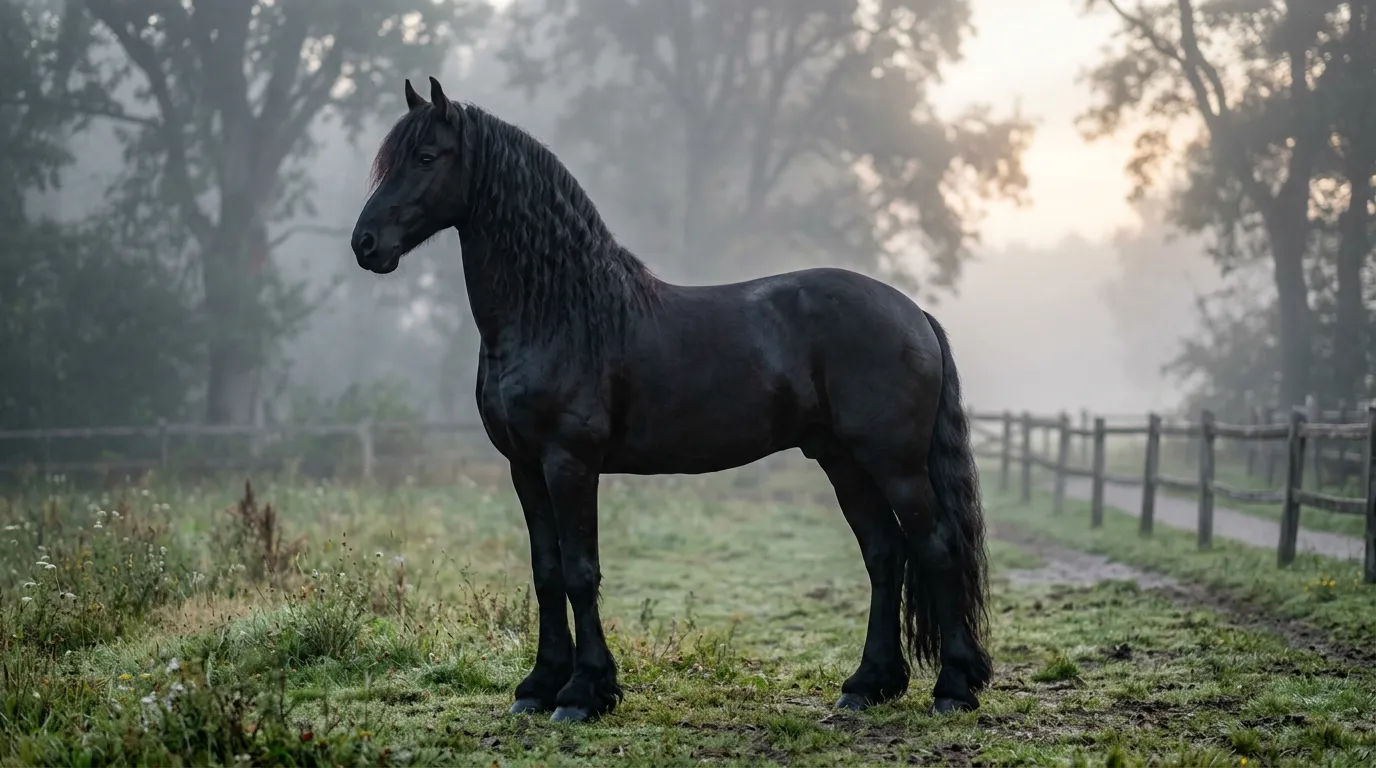
Genuine black is rarer than it looks. Most horses that read as "black" to the eye are actually a very dark bay or a black that fades to brown at the muzzle and flanks in summer sun: true black, which holds a deep, cold blue-black shade year-round with no tan points at all, shows up in only a handful of breeds with any consistency. The Friesian is the breed built entirely around it; the Shire, the Fell and Dales ponies, and individual Thoroughbreds, Warmbloods, and Cobs carry it too, without it being a breed hallmark.
Further reading · British Horse Society →
A true black coat photographs like nothing else: and a framed portrait canvas is the format that does it justice.
Which piece suits a black coat
A black horse rewards a portrait canvas, where the coat has room to hold its depth instead of flattening into a silhouette. Typography on cream paper does the opposite, so a name print is better bought as the companion piece than as the main one. The full range is on the personalised gifts page.
Why true black is rarer than owners think
Coat colour genetics explain the rarity. Black comes from a horse carrying two copies of the recessive extension gene with no agouti restricting it to points only, get that combination and the whole coat stays black. Miss it slightly and you get a dark bay, which is far more common and which sun-bleaches to reveal tan or brown around the muzzle, flanks, and eyes by late summer. A horse that stays genuinely black through a full grazing season, with no fading at all, is doing something coat-colour-wise that most "black" horses on a yard aren't.
The Friesian is the one breed where true black is bred for rather than incidental: the KFPS studbook does not register any other colour. Shires and the native Fell and Dales ponies carry black commonly without it being compulsory to the breed standard. Individual black Thoroughbreds, Warmbloods, and Cobs turn up across the wider population; owners of these horses often tell us the coat is one of the first things people notice about the horse, precisely because it's unusual.
Photographing a black coat well
- Avoid direct midday sun. Harsh overhead light blows out highlights and flattens the coat to a matte grey in photos; overcast daylight or early/late golden hour keeps the depth and the blue-black sheen readable.
- Let some background contrast in. A pure-black horse against a dark stable interior loses shape; grass, a pale fence line, or open sky gives the outline something to sit against.
- Three-quarter angle over square-on. Catches the light along the shoulder and haunch, which is where the coat's sheen actually shows.
- Skip the tack for portraits. AI-generated bridles and rugs can render oddly against solid black; a clean head-and-shoulders or three-quarter shot works best for a portrait canvas.
Which format suits a black coat
A black coat is exactly the kind of visual detail a printed portrait captures and a typographic name print can't, so the portrait canvas is the format worth spending on, and the framed 40×50cm variant if it is going on a main wall. If your horse is a specific breed with black in the coat, our dedicated guides for Friesian, Shire, and Thoroughbred owners go into more breed-specific detail; this page is for anyone whose horse is simply, strikingly black regardless of breed.
A black horse is chosen for the wall before the breed, so the personalised pieces do the work a breed badge cannot: the horse's own name carries the page. The owner's guide covers the rest of the brief.
Written by Craig Fearn, Stable & Hoof. Last updated .
Questions, answered
Do you make personalised gifts for black horse owners specifically?
What's the best gift for a black horse's owner?
Is my horse actually black, or dark bay?
How long do black horse gifts take to arrive?
Also in choosing your horse
Try it
Type a horse's name and watch the print set itself. Free, no photo needed, about ten seconds.