Cobs
The family horse for half the country, cobs do the school-master job for a generation.
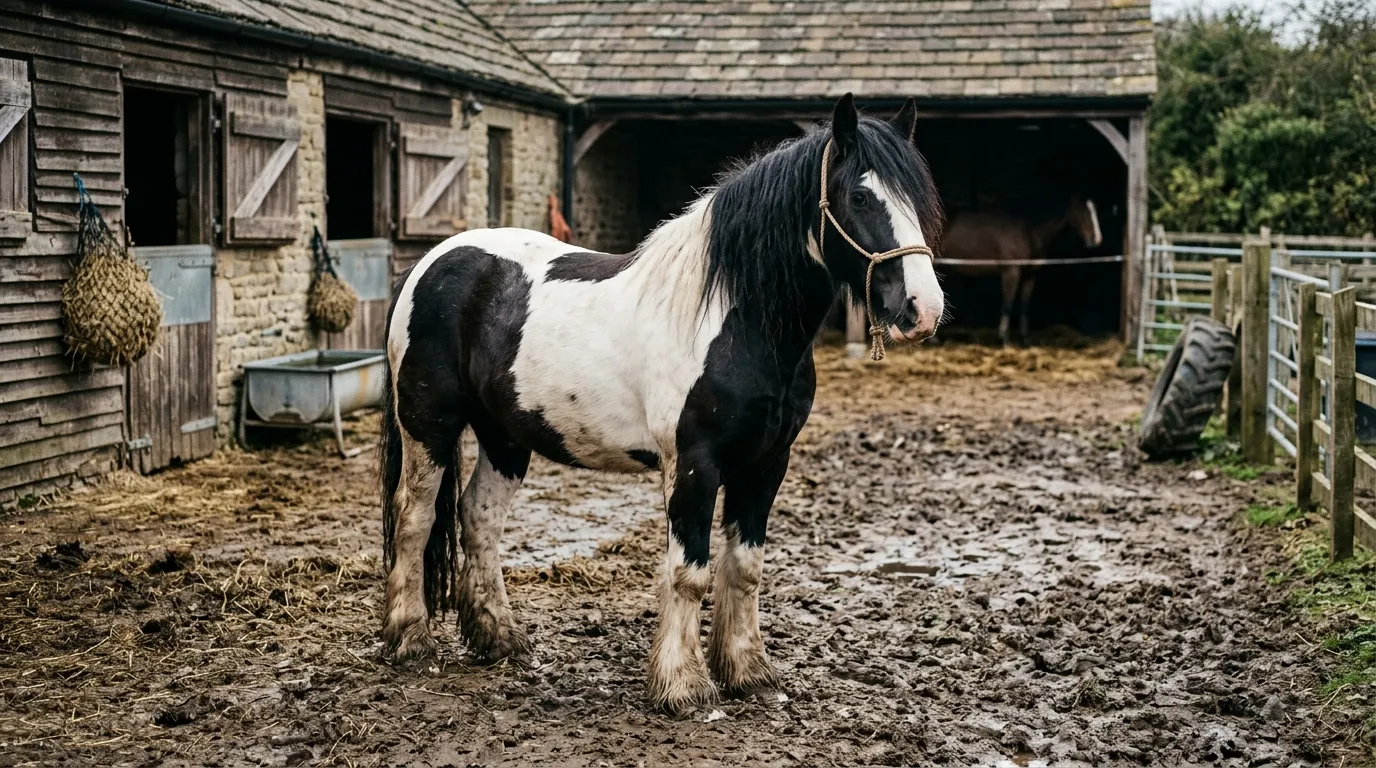
The cob is a type rather than a strict breed: the umbrella covers Welsh Section D Cobs, Traditional Cobs, Gypsy Cobs (sometimes called Vanners). Some individual Irish Draughts are of stockier, cobby build, though the Irish Draught is a studbook breed in its own right rather than a cob type. The unifying traits are stocky body, deep girth, full feathered legs, and a temperament steady enough that half of Britain's riding-school children learnt on one. The Show Cob class at county shows is one of the most-watched.
For cob owners the horse is usually the family's horse: hacking, hunting in the slow field, Pony Club, riding-club one-day events. Bays, piebalds, and skewbalds are the volume colours; solid blacks and greys turn up too. We ship more A3 prints to cob owners than any other variant: the breed's scale fits the larger format, and the typography frames the horse as a family member rather than a competition asset.
Further reading · Traditional Gypsy Cob Association (TGCA) → · British Horse Society →
Cob owners care about how the horse fits the family's riding life, not how it breeds. A name print frames the horse as part of the household.
What suits a cob household
Cobs are family horses, so the gift usually belongs in the house and not the tack room. A name print with the cob's type under the name does that job and needs no photograph, which helps when you're buying for someone else's horse. If you do have a good photo, the portrait canvas is the step up, and the personalised gifts page has the sizes.
Where the cob types come from
The word 'cob' is older than any of the registries that now claim it. For centuries it just meant a short-legged, big-bodied horse that could carry a heavy farmer all day and still pull the trap to market on Sunday. Function first, paperwork later. That history is why a cob is a build, not a bloodline: you can breed towards the shape from several directions and still land on the same horse.
The Traditional and Gypsy Cob lines came up through the Romani and Traveller communities of Britain and Ireland, bred for temperament and toughness on the road. Coloured coats (piebald and skewbald) were prized partly because a marked horse was easier to identify and trade. The Welsh Section D Cob is a separate, registered story: over 13.2hh, registered with the Welsh Pony & Cob Society, with the rolling 'cob movement' that wins ridden classes at the Royal Welsh. Then there's the Irish Draught and the lighter riding cob, the show-ring type clipped out for hunter-cob classes. Different roots, one silhouette.
Height is where people get caught out. There's no fixed cob breed standard the way there is for a Thoroughbred (cob is a show type, not a registered breed, per the British Show Horse Association) — BSHA's own show classes split cobs at 148-155cm (roughly 14.2-15.1hh), with taller individuals shown separately as Maxi Cobs up to a recommended 160cm, with the Gypsy Cob often stockier and lower-set than its height suggests. British Show Horse Association rules require registered show Cobs to carry a minimum of 8½ inches (lightweight) or 9 inches (heavyweight) of bone below the knee, which is the whole point. The legs do the work.
Temperament, jobs, and the gift that fits
Here's the thing about cobs. The sense is real, not marketing. Generations of breeding for a horse that a child, a nervous adult, and a hunting farmer could all ride produced a temperament that forgives a lot. Not bombproof (no horse is) but level-headed in the way that matters when traffic goes past or the saddle slips. Owners will tell you the cob looked after them through their worst riding year. They usually mean it literally.
The jobs match the temperament. Cobs do everything the family throws at them: hacking, riding-club dressage, the slow field out hunting, Pony Club, Riding for the Disabled, carriage driving, and the occasional unbothered cross-country round. They're not built for the manège at advanced level and most owners don't ask them to be. What a cob owner values is reliability and character, which changes what reads as a thoughtful gift. The horse isn't a competition asset to them, it's a member of the household who happens to live in a field.
That's why the personalisation that lands here is plain and warm rather than pedigree-heavy. A name print with the horse's name in display serif, the yard, and a date that means something to the family (first ride, a tenth summer together) does more than a list of breeding lines a cob owner probably can't recite and doesn't care about. For the coloured cobs especially, the markings are the horse, so a portrait canvas that catches the actual piebald pattern often beats type alone. A lot of cob gifts get bought for the rider in the family: children, partners, parents who got back in the saddle late. The ones that get reordered are the gifts horse owners can hang in the kitchen, not the tack room. If you're shopping for a rider whose first proper horse was a cob, that's the one print they'll keep when the next horse comes along.
Occasions run through the same register: for the family calendar the birthday list is the starting point, and a cob's working years are exactly what the retirement pieces were drawn for.
Written by Craig Fearn, Stable & Hoof. Last updated .
Questions, answered
Do you make personalised gifts for Cob owners specifically?
What are the most popular gifts for Cob owners?
Can I include the yard name on a Cob gift?
How long do Cob gifts take to arrive?
Also in choosing your horse
Try it
Type a horse's name and watch the print set itself. Free, no photo needed, about ten seconds.