Hunters
Bone, substance, day in deep going: the British hunter is a type that survives.
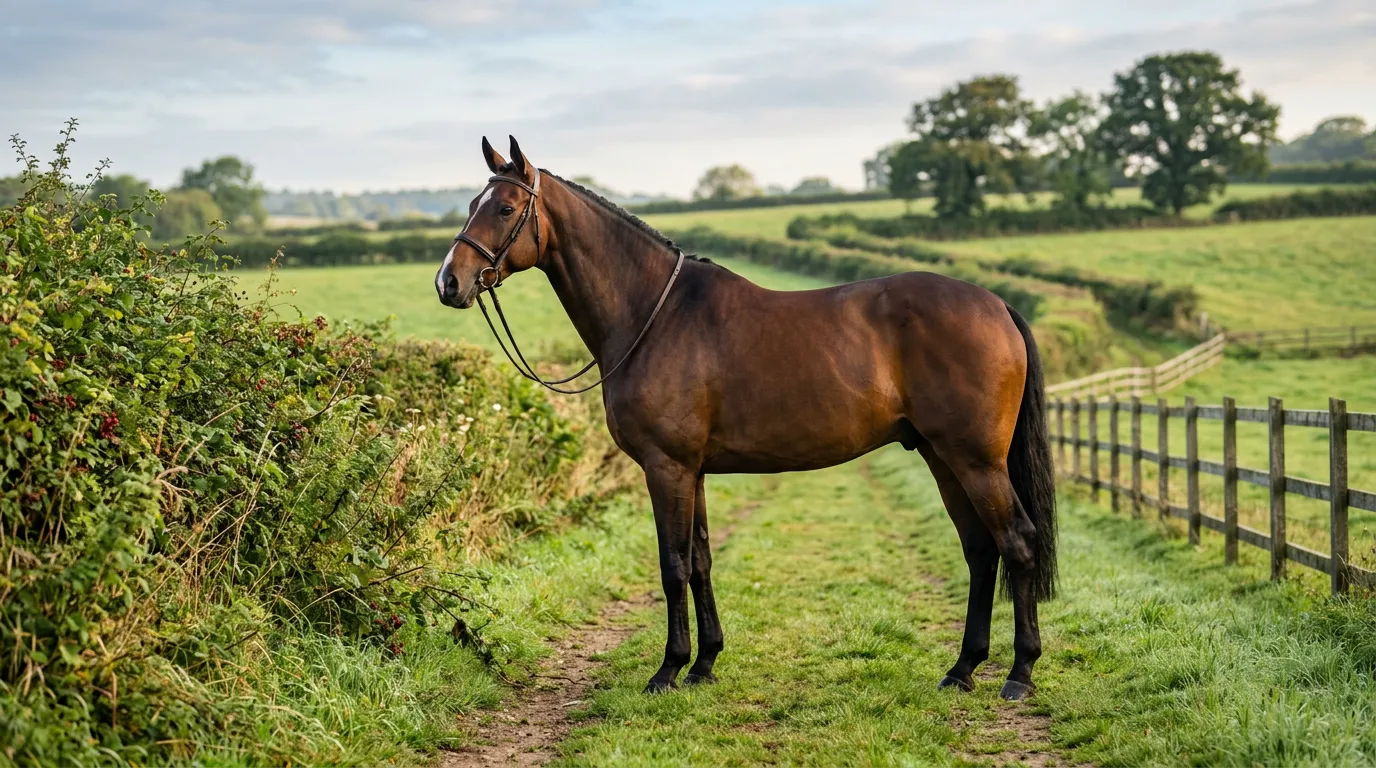
The hunter isn't a breed, it's a type. A British hunter is usually an Irish-bred Thoroughbred-cross or Irish Sport Horse, judged by weight-carrying capacity rather than a fixed height band (BSHA/SHB(GB) hunter classes start above 158cm/~15.2hh, with a separate Small Hunter division up to that height). The type is defined by bone, substance, and the temperament to gallop and jump for a five-hour day in deep going. The British Show Horse Association (BSHA) runs hunter showing, splitting classes into lightweight (carrying up to 12st 7lb), middleweight (up to 14st), and heavyweight (over 14st), plus working and small-hunter divisions.
Hunter owners are split between hunting people (where the horse does the actual job) and showing people (where the horse competes for type). Both communities buy gifts that look right in a traditional tack room (cream walls, dark wood, polished tack) rather than a modern stable-block office. The A3 print in a natural wood frame is the standard hunter-yard piece; mug ownership is universal.
Further reading · British Show Horse Association (BSHA) → · British Horse Society →
A hunter's tack room runs on tradition. A name print in a natural wood frame fits among the prints of past horses already on the wall.
What fits a hunting tack room
The wall is usually already full of prints of horses that came before, so a name print in natural wood joins something rather than interrupting it. The portrait canvas is the choice when this horse is the one being singled out. Both are listed with sizes on the personalised gifts page.
What the hunting field actually asks of the horse
A good hunter is bred for the going, not the ring. The job is honest and hard. You hack to the meet, stand around in the cold while hounds are drawn, then go from nothing to a full gallop across plough, grass, and heavy clay: sometimes for four or five hours, often in November rain. That's why the type favours bone, a deep girth, and a generous front. A flashy mover with no engine washes out by Boxing Day.
Temperament does most of the work. A hunter has to stand quietly in a crowded field, ignore hounds running under its feet, then jump a blind hedge off a half-stride with a rider who can't see the landing. Bold but sensible. The Irish Draught cross gives a lot of the calm; the Thoroughbred blood gives the gallop and the recovery. Most British hunters sit somewhere on that spectrum, which is why no two look quite alike: substance at one end, quality at the other.
Then there's the jumping. A hunter pops out of deep ground and rebalances fast, because the next obstacle might be a ditch with a rail behind it. Tidy in front, careful behind. Owners who hunt regularly talk about a horse being 'a proper conveyance', meaning it carries them safely all day and gets them home. That phrase tells you everything about what these horse owners value, and it's nothing a showing rosette measures. For the people who do the actual job, a portrait canvas of the horse at the meet (pink coats (the traditional red hunt coat), hounds, frost on the grass) captures the part of the year they wait for.
Colours run traditional. Bay leads, then chestnut and grey, with the odd brown or roan. White markings are common and nobody minds; a hunter is judged on how it crosses a country, not on a clean leg.
Choosing a gift for someone who hunts or shows
The hunting people and the showing people want slightly different things, and it pays to know which you're buying for. Showing owners produce a horse for type: they'll quote the weight class judged on the Sport Horse Breeding of GB circuit, the producer's name, and the qualifier the horse won. A name print that records the show result, framed in natural wood, reads as informed. These are the equestrians who notice typography, so the breed line in small caps with the horse's name above it lands properly.
Hunting owners are different. They care less about a rosette and more about the seasons the horse has given them: first whip's horse, ten seasons with the same pack, the day it jumped the big hedge at the boundary. For them the gift marks a relationship, not a result. A name print with the horse's name, the hunt, and a run of years works far better than anything competition-flavoured.
Both groups keep their pieces in a particular kind of room. The traditional tack room (cream walls, dark wood, polished leather, prints of past horses already up) sets the frame for what fits. Anything glossy or modern looks wrong on that wall. Dark-framed prints belong; brushed-aluminium does not. Worth knowing if the gift is meant to live where the saddles do.
A few practical notes for getting the personalisation right:
- Use the hunt's name, not 'hunting': the Quorn, the Beaufort, the Cottesmore, the local farmers' pack, the name means something to the owner and dates the print to a real chapter.
- Seasons, not a single year: hunters give long service. 'TEN SEASONS' or a year range reads truer than a one-off date for a horse that's done the job a decade running.
- Mind the difference between a hunter and a hunting cob: a 16.2hh middleweight and a chunky 15hh cob aren't the same type. Get the height and build right if the owner has told you.
- Memorials are common and should stay plain: hunters work into old age, and a print marking a long-served horse wants the name, the hunt, and the years, nothing sentimental layered on top.
- Ask who runs the yard: grooms and stable managers who've kept a hunter fit through a season are sometimes the right recipient, not the owner, they did the 5am feeds and the post-hunt poulticing.
A season's worth of country belongs at scale: the large-format end is where a hunter portrait earns its hanging space.
Written by Craig Fearn, Stable & Hoof. Last updated .
Questions, answered
Do you make personalised gifts for Hunter owners specifically?
What are the most popular gifts for Hunter owners?
Can I include the yard name on a Hunter gift?
How long do Hunter gifts take to arrive?
Also in choosing your horse
Try it
Type a horse's name and watch the print set itself. Free, no photo needed, about ten seconds.