Shetland pony
The smallest British native pony with the biggest personality on the yard.
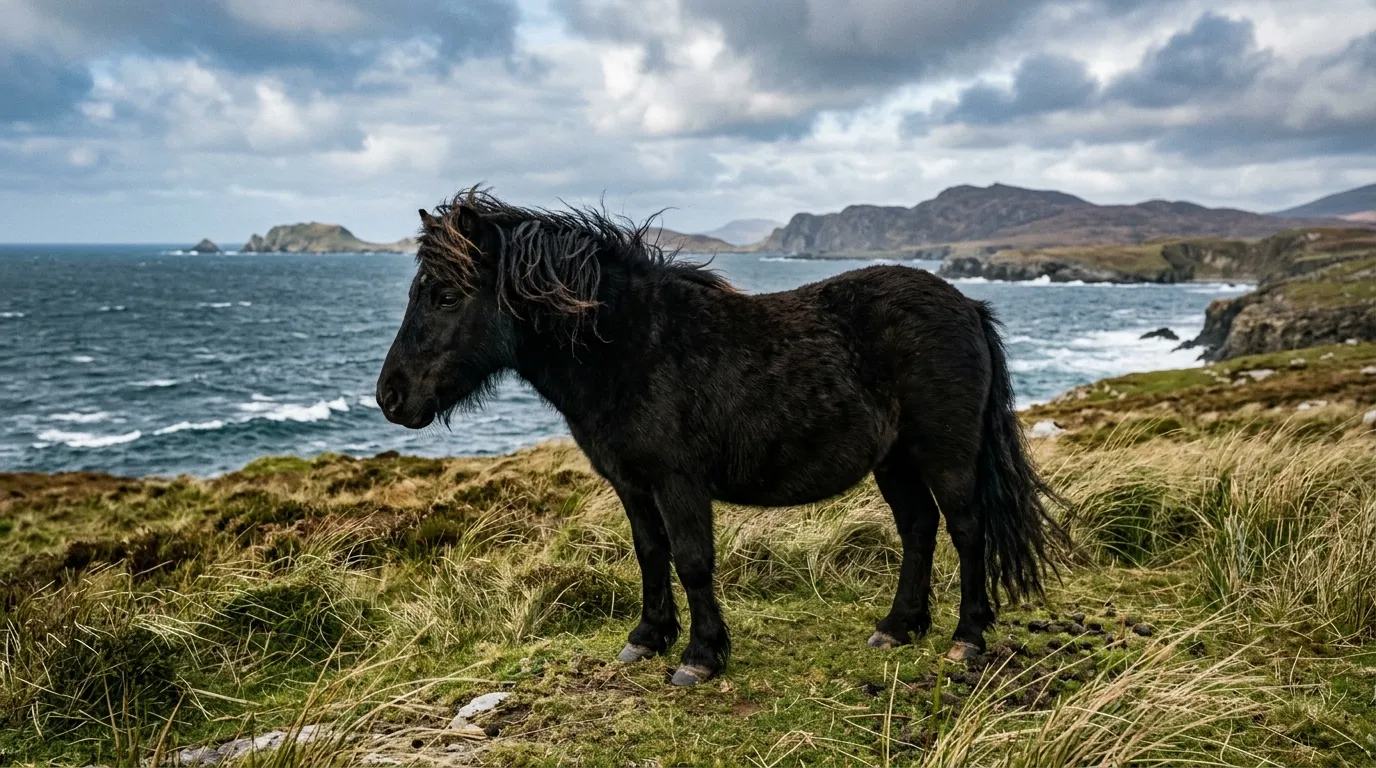
The Shetland is the smallest British native pony (under 42 inches at the shoulder, defined by the Shetland Pony Stud-Book Society) and one of the strongest pound-for-pound equines in the world, originally bred to haul peat and coal carts in the Shetland Isles. The double coat, full mane and tail, and characteristic large personality are part of why people choose the breed.
For most owners the Shetland is either the family's first pony (the kid is six, the Shetland is twenty-five and bombproof) or the family's last pony (the rider has scaled down from a 16hh sport horse to a companion). Either way the bond is unusually intense for the pony's size. Black, bay, chestnut, and skewbald dominate; the miniature classes show every coat. The portrait canvas is what we ship most often for Shetland orders, the breed's expressive face is what owners want captured.
Further reading · Shetland Pony Stud-Book Society → · British Horse Society →
A Shetland's expression is half the reason people own one. A portrait canvas captures it; a generic pony print misses it.
What to buy a Shetland owner
Half the reason people keep a Shetland is the face, and only a portrait canvas from your own photograph keeps it. A generic pony image misses entirely. The name print is the gift for the pony shared between children, who never stands still for a camera anyway. Every size we make is priced on the personalised gifts page.
Standard, miniature, and a strength that isn't a myth
The Shetland Pony Stud-Book Society splits the breed by height at two points. The Shetland Pony Stud-Book Society sets a single maximum of 42 inches for registered stock, measured withers-to-ground with a stick; the Society also runs separate 'standard' and 'miniature' champion classes at shows such as the Royal Highland, though the numeric split between them isn't stated in the material we could verify. The Society's rule book states only a maximum height (42 inches), measured in inches with a measuring stick; no minimum height is mentioned in the standard, a quirk left over from the islands' own livestock tradition.
Pound for pound, the strength reputation is real. Widely reported in equestrian media as able to pull around twice its own bodyweight, though this figure is not traceable to the breed society or a cited study. and carry a grown adult on a short hack, which is why the islanders used them down the coal pits and across the peat banks long before anyone bred them down for the show ring. The short back, deep chest and dense bone do the work. You're not looking at a scaled-down horse: the proportions are different, built for haulage in foul weather rather than speed on flat ground.
The double coat is the other survival trait. In winter a Shetland grows a dense undercoat with long guard hairs over the top, and the heavy mane and forelock shed rain clean off the face. It's so effective that the breed's real management problem is the opposite of cold. Most UK Shetlands carry weight far too easily on spring grass, and laminitis is the single biggest health watch-point: strip-grazing, track systems and grazing muzzles are standard kit on a well-run Shetland yard. Anyone keeping one well is, in practice, a careful stable manager first.
Temperament is where the small-dog comparison gets earned. Shetlands are clever, opinionated, and quick to learn both the right answer and every shortcut around it. Handled with consistent boundaries they're superb; left to their own devices they'll teach themselves to open gates. That intelligence is why the breed reads so well in a portrait: the expression actually tells you something.
What Shetland owners do, and what to buy them
The Shetland isn't only a child's lead-rein pony, though that's the common picture. Driving is the breed's competitive home (from single private driving classes up to the scurry teams that fly round the arena at major shows) and in-hand showing draws serious breeders to the Royal Highland and the breed society's own performance classes. Then there's the Shetland Pony Grand National, a charity racing series with child jockeys that races annually at the London International Horse Show (held at Olympia until 2020, now at ExCeL) among other UK and international shows. The point for a gift-buyer: this owner's pony probably has a job, and naming that job lands better than a generic pony phrase.
Whichever camp you're in, the breed's scale changes the brief. A Shetland's defining feature is its face (the dense forelock, the bright eye, the cheeky set of the ears) so head-and-shoulders crops work better here than they do for a leggy Thoroughbred. Photograph in outdoor light, get down to the pony's eye level rather than shooting from above, and let the mane do its thing. Most of the horse owners and riders we ship Shetland orders to want the personality on the wall, and with this breed the personality lives in the eyes.
- For the first-pony family: a name print dated to the season the child took over the feeding and grooming themselves reads as a real milestone, not a novelty, the moment a Shetland stops being a pet and becomes the kid's responsibility.
- For the companion-pony owner: plenty of Shetlands are kept purely as field companions to bigger horses, and these owners adore them disproportionately. A portrait canvas that captures the face and the full forelock is the order that gets reordered.
- For the driving or showing breeder: get the prefix right and the breed line correct. These equestrians notice when personalisation is informed, and a print that pairs the registered name with the home name carries weight.
- For the grandparent who pays the bills: they're often the quiet engine behind a Shetland and the easiest person to overlook. A gift that names the pony tells them the connection was noticed.
Small ponies, small budgets, real occasions: the under-twenty-five shelf was drawn with this breed in mind. At the other end of the native pony range sits the Welsh Pony, the usual next step once a child outgrows a Shetland.
Written by Craig Fearn, Stable & Hoof. Last updated .
Questions, answered
Do you make personalised gifts for Shetland Pony owners specifically?
What are the most popular gifts for Shetland pony owners?
Can I include the yard name on a Shetland Pony gift?
How long do Shetland Pony gifts take to arrive?
Also in choosing your horse
Try it
Type a horse's name and watch the print set itself. Free, no photo needed, about ten seconds.