What do you say when someone loses a horse?
Use the horse's name, say one specific thing you remember about them, and resist the urge to look for a silver lining.
There’s no correct sentence, and anyone offering you one is guessing. What follows is only what tends to land better, from people who have been on the receiving end of it.
Use the horse’s name. “I'm so sorry about Bramble” does more than “sorry for your loss”, because it says the horse was a particular animal and not a category. Say one specific thing you remember: how he was at a gate, what she was like to hack out with, the thing he did that nobody else’s horse did.
Two things to avoid. Anything beginning “at least”, which asks the person to feel better on your schedule. And “you can always get another”, which is heard as a suggestion the horse was replaceable. If you’re close enough, offering a specific practical thing (mucking out, a lift, feeding the field-mate) is worth more than any wording.
What tends to help, and what does not
| Tends to help | Tends to hurt |
|---|---|
| “I’m so sorry about Bramble.” | “Sorry for your loss” with no name |
| One thing you remember about the horse | “At least he had a good life” |
| “Can I do the field-mate’s hay this week?” | “You can always get another” |
| A message on the anniversary | Never mentioning the horse again |
Writing in a card
Keep it short and particular. Two lines are plenty: the horse’s name, and one memory. “Thinking of you and Bramble. I’ll always picture her pulling faces at the farrier.” If you did not know the horse well, say what you saw: “Anyone could see how much he meant to you.”
At the yard
On a shared yard the loss is visible to everyone: the empty stable, the headcollar still on its hook, the field-mate calling. Small things help. Leave the stable as it is until the owner is ready to clear it, don't move their kit without asking, and if the remaining horse needs company or extra checks, offer to cover some of them. Some yards plant a tree or hang a nameplate; ask the owner before arranging anything for them.
When it was a child's pony
Say the pony's name to the child too, and let them talk about it. Children often ask direct questions about what happened, and plain, kind answers do better than phrases such as "gone to sleep", which can make a young child anxious about sleep itself.
Later on
Grief for a horse is often lonelier than people expect, because the people around the owner may not share it. A message a few months on, or on the anniversary, tells them the horse is remembered by someone else too.
If the practical side is what they are facing next, what happens after a horse dies and what to do with the passport are both written for that week, not for a search engine.
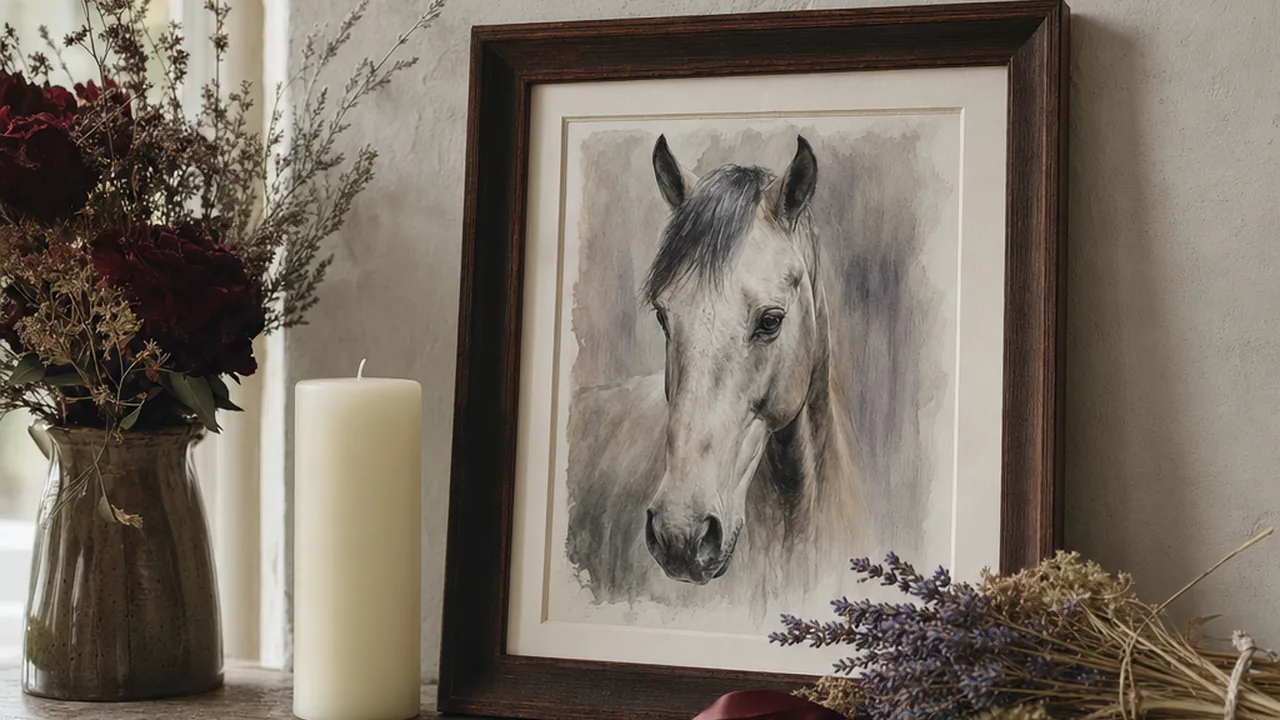
If you’re sending something with the card, our memorial prints are made to order with the horse’s name.