New Forest pony
Hampshire-born, semi-feral, the British family's native pony.
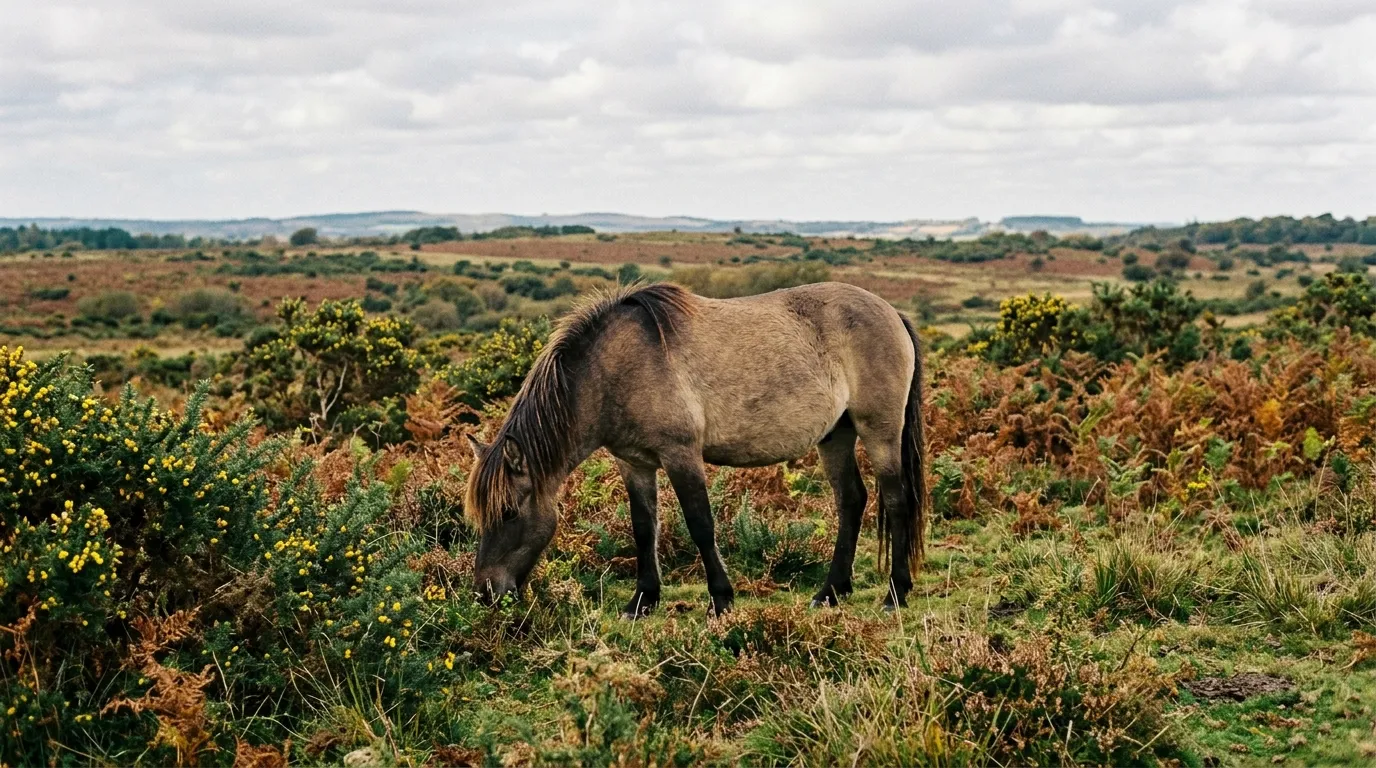
The New Forest pony is one of the recognised British native breeds, running semi-feral on the Crown lands of the Hampshire New Forest for at least a thousand years. The Verderers of the New Forest still administer commoners' rights and the annual round-ups (the "drift") where ponies are gathered for a health check, worming, hoof trimming and tail marking. The breed standard sets a maximum height of 148cm (about 14.2¾hh) and no minimum.; bay, chestnut, grey, dun, and palomino are all permitted by the breed standard, with no white markings other than a small star or sock.
The New Forest Pony Breeding & Cattle Society administers the studbook and licenses approved stallions for use on the Forest. UK New Forest ponies overwhelmingly do Pony Club, riding-club work, light eventing, and family hacking. Owners we ship to are most often parents or grandparents buying for a child rider on the same pony they grew up with.
Further reading · New Forest Pony Breeding & Cattle Society → · British Horse Society →
Most New Forest pony orders we ship are for Pony Club children or grandchildren: the pony has the kid's name on it before the kid has the pony's.
Buying for a Pony Club household
Most New Forest orders go to children, and a name print is what ends up above the bed. It needs no photograph, which matters when the pony is on loan or shared between families. A portrait canvas suits the end of a pony's time with one child better than the start of it. Prices sit on the personalised gifts page.
A thousand years of outside blood
The New Forest pony's history isn't a closed studbook story. It's the opposite. For centuries the Forest commoners turned out whatever improving blood they could get hold of, and the modern pony carries the marks of all of it. There's documented Thoroughbred, Arab, Welsh, Hackney, Highland, Dartmoor, Exmoor and Fell influence going back to the 1800s. Queen Victoria even lent an Arab stallion to run on the Forest in the mid-19th century.
That open chapter ended in the early 20th century. After that the studbook closed to outside blood, and what survived was a pony shaped far more by the ground than by any single foundation sire. A thousand years on poor Hampshire heath, gravel and bog does its own selective breeding. The ponies that bred on were the hardy, sound, sure-footed ones: the soft-footed and the greedy didn't last a winter out on the Forest.
You can read that history in the conformation. A good New Forest pony has a workmanlike, slightly long body, a deep girth for its height, short hard legs and famously good feet. The larger Forest type can stand a genuine 14.2hh and carry a slight adult; the smaller ones make ideal first ridden ponies. Heads are sensible rather than pretty: there's Forest pony, not show-pony refinement, and owners tend to like it that way. If you know a Forest owner well enough to be reading this, a name print that records the pony's height, colour and the year it came off the Forest tells that whole story in three lines.
Bay and brown dominate the working population, with chestnut, grey, dun and palomino all permitted. Piebald and skewbald are not, and a knowledgeable owner will tell you so before you ask. White is limited to a small star or the odd sock by the breed standard, which is why a portrait of a Forest pony is mostly an exercise in getting the brown right.
The all-day pony, and what to buy its owner
Temperament is the New Forest pony's strongest selling point. Generations bred semi-feral around traffic, picnickers, cattle grids and the general chaos of a busy national park have produced a pony that's hard to spook and easy to handle. They're sensible, willing and notably honest: they'll think about a question rather than panic at it. That's a different reputation from the sharper native breeds, and it's exactly why so many of them end up as a family's all-day pony.
Discipline-wise, the Forest pony is a true all-rounder rather than a specialist. You'll find them across Pony Club, riding club, lead-rein and first ridden classes, working hunter pony, mounted games, hunting, low-level eventing and long-distance riding. The breed has a real reputation in driving too: the lighter, faster Forest pony goes well in harness, and Forest ponies turn out at the bigger driving events every year. Few breeds cover this much ground while staying genuinely safe for a child.
All of that shapes what's worth buying for the owner. This pony rarely belongs to a single rider. It's the one a child learns on, then a younger sibling, then sometimes the next generation: the same hardy temperament that survived the Forest tends to survive decades in a paddock too. So gifts for these owners are usually about continuity, not a single competition season.
- The pony outlasts the rider: a 25-year-old Forest pony still doing lead-rein duty isn't unusual. A portrait canvas tends to get commissioned when one child grows out of the pony and a younger one grows into it.
- It's a working family pony, not a show object: most go to ordinary horse owners and Pony Club families rather than the showing circuit, so plain, honest personalisation reads better than anything fancy.
- The Forest itself matters: if the pony was Forest-bred and gathered at a drift, owners often want that on the gift. A line like 'NEW FOREST · 13.2HH · BAY · BURLEY' means something to them and nothing to a content mill.
- Children's riders are the core occasion: for young riders and the grandparents buying for them, a birthday or first-rosette gift dates the start of a long partnership rather than marking its end.
For first rosettes and family birthdays alike, the birthday range is the natural shelf for this breed. Families choosing between native breeds usually also look at the Connemara, which carries a child further up the heights.
Written by Craig Fearn, Stable & Hoof. Last updated .
Questions, answered
Do you make personalised gifts for New Forest Pony owners specifically?
What are the most popular gifts for New Forest pony owners?
Can I include the yard name on a New Forest Pony gift?
How long do New Forest Pony gifts take to arrive?
Also in choosing your horse
Try it
Type a horse's name and watch the print set itself. Free, no photo needed, about ten seconds.